



Frescoes of the Panagia Moutoulla Church


All the frescoes of the Sacred Step and the main temple date back to 1280, when the temple was built. They are distinguished by their linear austerity, the limited color scale and the bad proportions of the figures. The bodies are dull, the heads disproportionate to the bodies, the eyes wide open with the daughter pointed. The painter is unknown, but his style shows the effects of Byzantine models of the 12th century. and modern western painting.
The pictorial program has several originals, such as the representation of the military horse rider Ayios Christoforos, the adjective “THE KAPPADOS” in the image of the saint of Agios Georgios, the two coiled upright snakes in the performance of Annunciation and others. The image of the Seven Sleeping Children of Ephesus on the eastern side of the north outer wall is unique in Cyprus.
In December 1985 the church of Panagia Moutoulla was included in the UNESCO World Heritage List.
Location
Frescoes - Icons

Miraculous Icon of Our Lady
The icon of Panagia Rodon to Amaranto, which is located in the church, is considered to be miraculous. The image shows Christ and the Virgin Mary wearing crowns on their heads, with the Virgin holding a rose. The village of Kato Koutrafas is located a

Murals of the Agios Sozomenos Church
The church of Agios Sozomenos is located in the centre of the old village of Galata. It was built and frescoed in 1513, with the financial support of fourteen inhabitants of the village. Their names, as well as the professions of some of them, refer to
Murals of the Church of Archangel Michael
The church of Archangel Michael is a wood-chapel church dating from the 16th century and is very close to the church of Panagia Podithou. Of particular interest is the landmark inscribed above the northern entrance where the devotee is pictured with hi
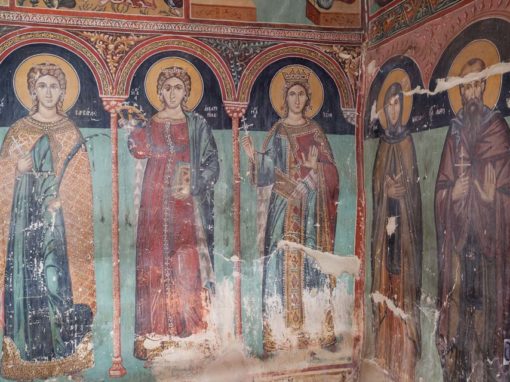
Murals of the Church of Panagia Podithou
At the dawn of the 16th century, in 1502, the frescoes of the Panagia of Podithou Church in Galata, with Italian-Byzantine-style frescoes, are considered as a stage in the evolution of art in Cyprus. Its main features are bright colours and third-dimen

