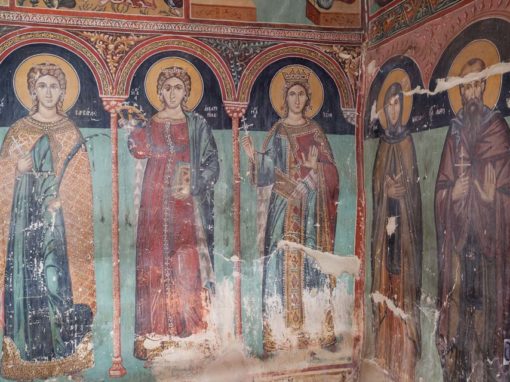
The Church of Panagia Asinou Frescoes


The church of Panagias Forviotissas, better known as Panagia Asinou, is built southwest of Nikitari village. The interior of the church of Panagia Asinou is documented. The frescoes that survive today belong to different chronological periods. The oldest set dates back to 1105/6 and expresses the new trends of the Komninon period painting. The narthex was decorated with frescoes shortly after its construction in the second half of the 12th century, and was refurbished in 1332/3 with intense Frankish influences. The fresco of Panagia Forviotissa is located at the entrance of the church on the drum of the arch. There are also some later frescoes dating to the 17th century.
The church celebrates on Easter Tuesday, and since 1985 it has been included in the UNESCO World Heritage List.
Tel.: +357 99 83 03 29
Working hours:
Daily
09: 30-17: 00 (May-August)
09: 30-16: 30 (September-October)
09: 30-16: 00 (November-April)
Location
Frescoes - Icons

Ikonofyakio (Pictorial)
On the south side of the monastery of Agios Ioannis Lambadistis, there is the ikonofylakio (pictorial), which has heirlooms of the entire community of Kalopanayiotis. Some of the items are invaluable, ancient and unique. All the items have their own si

Miraculous Icon of Our Lady
The icon of Panagia Rodon to Amaranto, which is located in the church, is considered to be miraculous. The image shows Christ and the Virgin Mary wearing crowns on their heads, with the Virgin holding a rose. The village of Kato Koutrafas is located a
Murals of the Agios Sozomenos Church
The church of Agios Sozomenos is located in the centre of the old village of Galata. It was built and frescoed in 1513, with the financial support of fourteen inhabitants of the village. Their names, as well as the professions of some of them, refer to

Murals of the Church of Archangel Michael
The church of Archangel Michael is a wood-chapel church dating from the 16th century and is very close to the church of Panagia Podithou. Of particular interest is the landmark inscribed above the northern entrance where the devotee is pictured with hi