



The Church of Panagia Asinou Frescoes


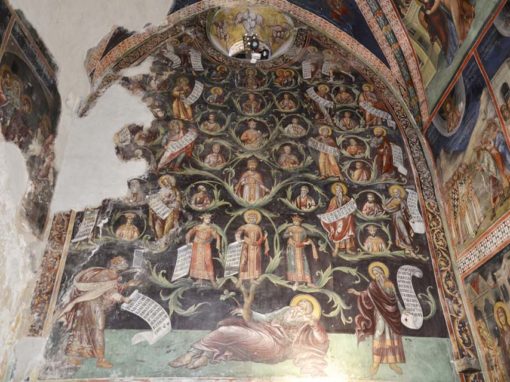
The church of Panagias Forviotissas, better known as Panagia Asinou, is built southwest of Nikitari village. The interior of the church of Panagia Asinou is documented. The frescoes that survive today belong to different chronological periods. The oldest set dates back to 1105/6 and expresses the new trends of the Komninon period painting. The narthex was decorated with frescoes shortly after its construction in the second half of the 12th century, and was refurbished in 1332/3 with intense Frankish influences. The fresco of Panagia Forviotissa is located at the entrance of the church on the drum of the arch. There are also some later frescoes dating to the 17th century.
The church celebrates on Easter Tuesday, and since 1985 it has been included in the UNESCO World Heritage List.
Tel.: +357 99 83 03 29
Working hours:
Daily
09: 30-17: 00 (May-August)
09: 30-16: 30 (September-October)
09: 30-16: 00 (November-April)
Location
Frescoes - Icons

Murals of the Church of Panagia Podithou
At the dawn of the 16th century, in 1502, the frescoes of the Panagia of Podithou Church in Galata, with Italian-Byzantine-style frescoes, are considered as a stage in the evolution of art in Cyprus. Its main features are bright colours and third-dimen

The Agios Nikolaos tis Stegis (St. Nicholas of the Shelter) Murals
The 12th century is considered as the golden age for Byzantine art in Cyprus, but also unique in the whole world, because the surviving ones from this period are limited. The frescoes that survive in Agios Nikolaos tis Stegis and especially those revea
The Monastery of Agios Ioannis (St. John) Lambadistis Frescoes
As seen in the decor and frescoes, the monastery flourished during the Byzantine period, as well as during the French Occupation (1191-1489) and the Venetian domination (1489-1571). The frescoes were created in different times, from the 11th to the 16t
The Panagia Odigitria (Virgin Mary The Guide) Icon
One of the most remarkable icons is that of Panagia Odigitria dating back to 1474. It belongs to the local iconographer Minas, who also painted the famous church of Archangel Michael. The icon is kept and displayed in the Byzantine Museum of Pedoulas.

