



Murals of the Church of Panagia Podithou
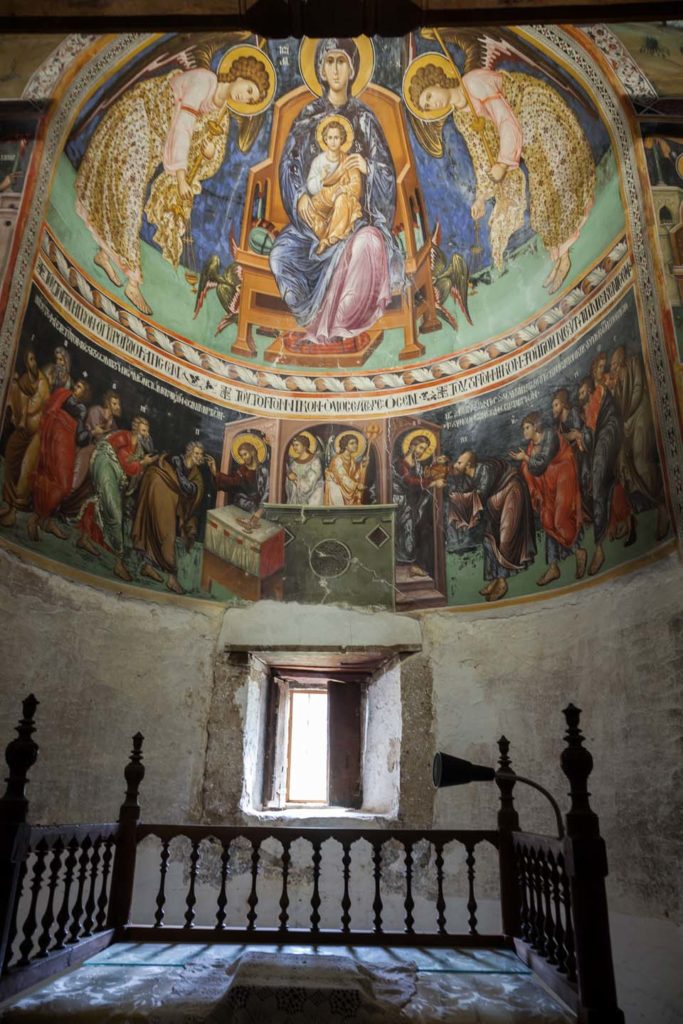


At the dawn of the 16th century, in 1502, the frescoes of the Panagia of Podithou Church in Galata, with Italian-Byzantine-style frescoes, are considered as a stage in the evolution of art in Cyprus. Its main features are bright colours and third-dimensional performance.
One of the most important sections of the church is the Sacred podium. The frescoes in the apse quadratheus, one of the most central points of the church, present the imposing representation of the Virgin Mary sitting on a wooden footstool, with Christ standing right in front of her body. The Archangels Michael and Gabriel gloriously worship the Blessed Virgin, holding gold candlesticks, censers, and lit candles.
At the top of the arch of the apse, the Apostles’ Revelation is depicted. Christ is represented twice followed by an angel.
In the pediment of the eastern wall of the altar the Holy Mandilion is depicted. Below this, on the left, Moses is depicted on Mount Sinai to receive the plaques of the Law from the hands of God, and on the right to solve his sandals in front of the Virgin’s vision as a flaming wad.
Most of the murals on the eastern wall of the altar have as their subject the Virgin Mary, with scenes from the beginning of her childhood cycle.
The main church remains untouched except for the west wall pediment. At this tall point a multifaceted composition of the Crucifixion is depicted. The narrative of this particular fresco shows a strong influence from Italian art.
Location
Frescoes - Icons

The Agios Nikolaos tis Stegis (St. Nicholas of the Shelter) Murals
The 12th century is considered as the golden age for Byzantine art in Cyprus, but also unique in the whole world, because the surviving ones from this period are limited. The frescoes that survive in Agios Nikolaos tis Stegis and especially those revea

The Church of Panagia Asinou Frescoes
The church of Panagias Forviotissas, better known as Panagia Asinou, is built southwest of Nikitari village. The interior of the church of Panagia Asinou is documented. The frescoes that survive today belong to different chronological periods. The olde
The Monastery of Agios Ioannis (St. John) Lambadistis Frescoes
As seen in the decor and frescoes, the monastery flourished during the Byzantine period, as well as during the French Occupation (1191-1489) and the Venetian domination (1489-1571). The frescoes were created in different times, from the 11th to the 16t
The Panagia Odigitria (Virgin Mary The Guide) Icon
One of the most remarkable icons is that of Panagia Odigitria dating back to 1474. It belongs to the local iconographer Minas, who also painted the famous church of Archangel Michael. The icon is kept and displayed in the Byzantine Museum of Pedoulas.

